There were similaries and differences between the economies of Germany and the United States during the 1930's and early 1940's. The two countries were the two largest economies in the world and produced together about half of the world industrial output during this one and half decade. WW2 can be partially understood as a conflict between these two emerging giants to retake the place of old England as the leading hegemon in the world. England was the largest economy in the planet during most of the 19th century, but by the early 20th century was surpassed by the United States and Germany. However, Britain continued to exert the role of the leading political and military power during the first four decades of the 20th century. This discrepancy between UK"s position and it's warmaking potential lead to a unstable political equilibrium which finally resulted into the two world wars.
Gross National Income
GNP's, billions of current dollars (1933-1939), and 1939 dollars (1939-1943)
--------- Germany ------------ USA ------ Germany/USA %
1933 --- 18.02 --------------- 56.40 ----- 31.95%
1934 --- 26.20 --------------- 66.00 ----- 39.70%
1935 --- 30.00 --------------- 73.30 ----- 40.93%
1936 --- 33.31 --------------- 83.80 ----- 39.75%
1937 --- 37.43 --------------- 91.90 ----- 40.73%
1938 --- 46.19 --------------- 84.70 ----- 54.53%
1939 --- 51.60 --------------- 90.50 ----- 57.02%
1940 --- 51.60 --------------- 98.65 ----- 52.30%
1941 --- 52.40 --------------- 110.14 ---- 47.58%
1942 --- 54.40 --------------- 114.48 ---- 47.52%
1943 --- 60.00 --------------- 122.89 ---- 48.82%
German GNP was usually half of the US's during the period. However, Germany's labor force was more than half of the size of the US labor force. US levels of labor productivity were significantly higher than in Germany.
Labor and productivity
Employed civilian labor force (the labor force that produces the GDP) in thousands
---------- Germany ------- USA
1938 ---------------------- 44,142
1939 ----- 39,415 ------- 45,738
1940 ----- 35,983 ------- 47,520
1941 ----- 36,177 ------- 50,350
1942 ----- 35,525 ------- 54,750
1943 ----- 36,529 ------- 54,470
1944 ----- 36,110 ------- 53,960
The levels of productivity of the German labor force were lower than the US's by a significant margin. In 1943, for instance, a labor force of 36.5 million produced 60 billion dollars, a productivity of 1,640 dollars while the US with 54.5 million workers produced 122.89 billion dollars, a productivity of 2,250 dollars per worker. German productivity per worker was around 70-75% of the US's. The main reason for such discrepancy was the backward German agriculture. Productivity in industry and services was comparable.
The lower level of productivity was reflected in wages. I have calculated elsewhere, using 5 goods and a German expenditure basket given by the census of 1937, that US 1935 real wages were 126% of the German level.
Capital Stock
In 1939, the German industrial capital stock was 55 billion reichmark, increasing to 71 billion reichmark in 1943, industry consists of manufacturing, construction and mining, and the capital stocks involving in mining and construction were very small in proportion to the whole industry, so this number is a rough indicator of the manufacturing capital stock of Germany. The US manufacturing capital stock was 39 billion 1945 dollars in 1939 and 65 billion 1945 dollars in 1945. Converted to 1939 dollars using the Friedman and Schwartz GDP deflator index yields 25.1 billion dollars and 41.9 billion dollars, or 63 billion and 105 billion Reichmarks, respectively. A logarithmic interpolation suggests a manufacturing capital stock of 89 billion reichmarks in 1943.
So we have:
Manufacturing capital stock, billion 1939 reichmarks
---------- Germany ------- US
1939 ---- 55 -------------- 63
1943 ---- 71 -------------- 89
So, while the US GNP was much larger than Germany's, the US capital stock wasn't much larger. That was reflected in the lower level of employment in the capital stock during the war. In Germany in 1942, 90% of the industrial labor force was in the first shift and only 7% in the second shift, which implies that 92.2% of the factories worked on a single shift basis. Compared to the UK the machine tool using industries, a set of industries which employed half of the total industrial workforce during the war, had one machine tool per 2.3 workers in Germany and one per 5.6 workers in UK in 1943. Germany's machine tool stock was even greater than the US's from 1940 to 1943:
---------- Germany ---------- US
1940 ---- 1,178,000 -------- 942,000
1941 ---- 1,306,000 ------- 1,054,000
1942 ---- 1,438,000 ------- 1,247,000
1943 ---- 1,555,000 ------- 1,529,000
1944 ---- 1,657,000 ------- 1,771,000
Germany's industrial capital stock per worker in the industries involved in war related production was greater than the US's. However, productivity was smaller. And also, total munitions output, specially in terms of combat aircraft, tanks and warships, was significantly smaller in Germany (Germany produced 53,400 combat aircraft and 32,000 tanks in 1943-1944, compared with American outputs of 128,200 combat aircraft and 59,000 tanks, plus the average American aircraft was significantly heavier than German aircraft). The explanation of this large discrepancy is the focus of the next section.
War effort: focus and outcome
American munitions production was significantly greater than Germany's. Specially regarding production of aircraft and warships. US warship production was 3.5 million tons while German production was only 1.25 million tons, during the whole war.
For instance, in the third quarter of 1943, Germany produced 35.25 million pounds of airframes in fighter pounds equivalents while the US produced 155.3 million pounds of fighter airframe equivalents. However, the average weight of the German fighter airframe was 3,200 pounds, while the average American fighter airframe was 4,800 pounds. Since the aircraft industry follows a 80% cost curve, the average German fighter airframe was equivalent in cost of production to a 3,650 pounds of American airframes (smaller airframes cost more per pound than larger ones). Therefore, German third quarter 1943 aircraft production was equivalent in value to 40.2 million pounds of American airframes. And in July 1943, the US airframe industry employed 1,084,000 workers, while the German airframe industry employed 373,000 workers. Therefore the productivity of the German airframe industry was 108 fighter pounds per worker per trimester, while the US airframe industry produced 143 pounds per worker per trimester.
But note that the overall labor forces employed in the war were more similar in size. In 1943, Germany had 9.5 million men in the armed forces, plus cumulative permanent losses of 1.7 million men and 6.6 million men employed in war related production. A total manpower mobilized for war of 17.8 million men. The US in 1943 had 9.03 million men in the armed forces, cummulative permanent losses of 0.1 million men and 12.3 million workers in war related industrial production. A total manpower mobilized for war of 21.4 million men.
So, the total manpower mobilized for war by Germany by 1943 was 83% of the US's manpower. Roughly proportional to the total size of the labor forces (including losses due to war) of 47.7 million for Germany and 64.5 million for the US in 1943 (Germany/USA % of 74%). However, the labor force employed in the airframe industry in Germany was 34.4% of the US's. If Germany employed the same proportion of the labor force allocated to war in the aircraft industry as the US in 1943, German aircraft output would have been 60,000 aircraft, assuming constant productivity (and the aircraft industry had increasing returns to scale in WW2).
Germany had a much larger army, 280 divisions, compared to 100 American divisions. And German production of ground combat related munitions was in fact greater than the US's during the war, that's because German ammunition production was greater, and ammunition was 80% of the ground combat related munitions production, while tanks, infantry weapons and everything else was only 20%.
A Comparison of American and German economies in WW2
-
Guaporense

- Banned
- Posts: 1866
- Joined: 07 Oct 2009, 03:35
- Location: USA
A Comparison of American and German economies in WW2
"In tactics, as in strategy, superiority in numbers is the most common element of victory." - Carl von Clausewitz
Re: A Comparison of American and German economies in WW2
Good morning Guaporense,
As soon as I read "airframes" in "fighter pounds equivalents" and "fighter airframe equivalents" I thought I was reading something by Vietnam War era US Defense Secretary Robert S. MacNamara.
You can write "industry consists of manufacturing,.." but without the inherently required logistics system the pound and airframe equivalents are merely overpriced distress merchandise. Review the economic doctrine of "place utility".
The "US capital stock wasn't much larger" than Germany's ?! No US capital stock in the extractive ore industry of Canada? ... the oil industry in Venezuela ? ... No capital stock in the Central American republics ? (Think of United Fruit Company, Chalk Airlines)
Well, the inference from the mentioned implication re a 90% staffed German first shift labor force and a 7% second shift yields nothing to me with a decimal point. (Your 92.2%)
Outside a contemporary highly charged political subject here in the US - especially in the US south - must decline to comment on "per trimester" with only the request that you use common denominators so I can try to figure out your message.
After Versailles, the UK "continued to exert the role of the leading political and military power..." ?! Review Statute of Westminster, 1931. Stuff was going on that you're omitting.
I question most in your post but not the UK's "discrepancy" and "unstable political equilibrium which finally resulted into the 2 world wars". This I refute. There were other major global factors and I do not allude to Soviet citrus production north of 60 degrees north latitude.
Do consider Japan and China being entitled to, at least, a footnote.
Warm regards,
Bob
As soon as I read "airframes" in "fighter pounds equivalents" and "fighter airframe equivalents" I thought I was reading something by Vietnam War era US Defense Secretary Robert S. MacNamara.
You can write "industry consists of manufacturing,.." but without the inherently required logistics system the pound and airframe equivalents are merely overpriced distress merchandise. Review the economic doctrine of "place utility".
The "US capital stock wasn't much larger" than Germany's ?! No US capital stock in the extractive ore industry of Canada? ... the oil industry in Venezuela ? ... No capital stock in the Central American republics ? (Think of United Fruit Company, Chalk Airlines)
Well, the inference from the mentioned implication re a 90% staffed German first shift labor force and a 7% second shift yields nothing to me with a decimal point. (Your 92.2%)
Outside a contemporary highly charged political subject here in the US - especially in the US south - must decline to comment on "per trimester" with only the request that you use common denominators so I can try to figure out your message.
After Versailles, the UK "continued to exert the role of the leading political and military power..." ?! Review Statute of Westminster, 1931. Stuff was going on that you're omitting.
I question most in your post but not the UK's "discrepancy" and "unstable political equilibrium which finally resulted into the 2 world wars". This I refute. There were other major global factors and I do not allude to Soviet citrus production north of 60 degrees north latitude.
Do consider Japan and China being entitled to, at least, a footnote.
Warm regards,
Bob
Re: A Comparison of American and German economies in WW2
Just a quick nitpick without going into the rest of the details:
Dietrich Eichholtz in his excellent "Geschichte der Deutschen Kriegswirtschaft", Vol. 3, reproduces data taken from some German comparative labour statistics for the mining industry, which, IIRC, suggest a higher differential in labour force productivity. For instance, it pointed out that productivity of a miner's working hour in the US was almost double as high in terms of physical output (black coal) compare to one in Germany. Again, IIRC, it also pointed out similar differentials in other industrial sectors or branches and as a result assessed the German economic situation near completely hopeless.The levels of productivity of the German labor force were lower than the US's by a significant margin. In 1943, for instance, a labor force of 36.5 million produced 60 billion dollars, a productivity of 1,640 dollars while the US with 54.5 million workers produced 122.89 billion dollars, a productivity of 2,250 dollars per worker. German productivity per worker was around 70-75% of the US's. The main reason for such discrepancy was the backward German agriculture. Productivity in industry and services was comparable.
Re: A Comparison of American and German economies in WW2
Whats the impact of Agriculture on those figures? Germany had a productive ag sector but was labour and fertilizer intense (productive in yield per acre) the US with much more land was more focus on productive in labour rather than land terms. What percentage of the GDP is ag sector? (is a big enough to be a factor? )
oops missed the sentence - "The main reason for such discrepancy was the backward German agriculture."
But still got a percentage breakdown of sectors? Ag, mining, industry ?
oops missed the sentence - "The main reason for such discrepancy was the backward German agriculture."
But still got a percentage breakdown of sectors? Ag, mining, industry ?
-
Guaporense
- Banned
- Posts: 1866
- Joined: 07 Oct 2009, 03:35
- Location: USA
Re: A Comparison of American and German economies in WW2
In mining German productivity was always lower. British productivity in mining was even lower than in Germany as well. But overall, the level of economic productivity in Britain was not that significantly lower than in the US. And German manufacturing and transport productivity (railroads) was greater than British (estimated rigorously at ca. 110% of British productivity in 1938).Michate wrote:Just a quick nitpick without going into the rest of the details:
Dietrich Eichholtz in his excellent "Geschichte der Deutschen Kriegswirtschaft", Vol. 3, reproduces data taken from some German comparative labour statistics for the mining industry, which, IIRC, suggest a higher differential in labour force productivity. For instance, it pointed out that productivity of a miner's working hour in the US was almost double as high in terms of physical output (black coal) compare to one in Germany. Again, IIRC, it also pointed out similar differentials in other industrial sectors or branches and as a result assessed the German economic situation near completely hopeless.
Coal mining was only a small fraction of the economies of any country involved in WW2. In Germany I believe about 0.4 - 0.5 million workers were employed in mining, that's 1% of the labor force and should not be taken as representative of overall productivity. Here I did an aggregate approach: compared the whole GNP and divided by the whole labor force.
Let's compare productivity in the munitions industries:
For instance, productivity in munitions was not that lower than in the US. If fact, it may have been higher, at least in some sectors. Germany produced U-Boats with a greater worker productivity than the US produced submarines.
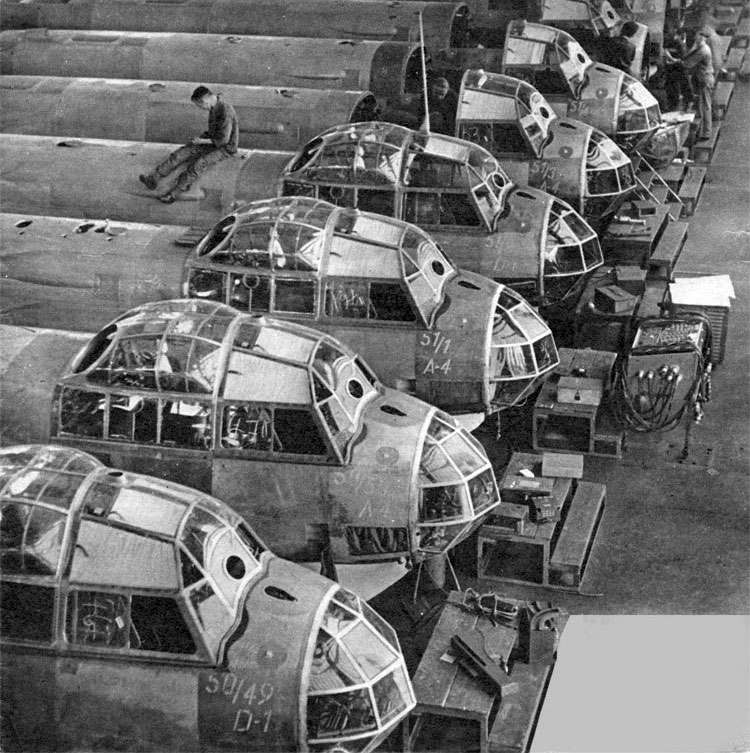
The production of medium bombers, such as the Ju-88, which consumed only 15,000 hours of work already in 1941, per unit (all, including aero engines and airframe), was very efficient. By 1943 Junkers was producing Ju-88 at 7,000 hours per plane. It had an empty weight of 9,860 kg. A total of 16,000 Ju-88 were produced in Germany, it was the most common bomber made in Germany during the war.
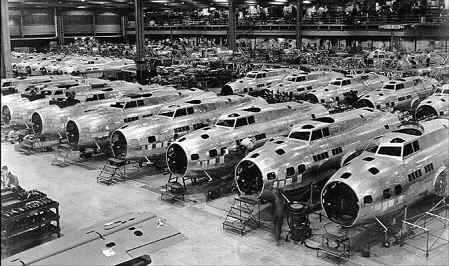
In 1941 the US was producing the heavy bomber B-17 at 55,000 hours worked per plane, by 1944, it dropped to 19,000 hours per plane. The B-17 had an empty weight of 16,210 kg. A total of 13,000 B-17 were produced during the war. Both aircraft represented the gains of economies of scale in their manufacture.
So let's compare productivity in bomber manufacturing, labor hours per ton:
--------- Germany ------- US
1941 -- 1,521 ----------- 3,393
1943 -- 710 -------------- NA
1944 -- NA --------------- 1,172
So, German productivity in making bombers was in fact much higher than in the US during the war. The claim that US productivity was much higher across the board is clearly refuted.
As the production of single engine fighters, such as the Me-109, whose production took less than 2,000 man hours to produce in 1944. German production of fighters was also more efficient, considering they were making a Me-109 for the same RM price as the price of a Mustang in US$ dollars, which would mean half of the production cost!
Since German industry operated on a single shift basis while US industry operated on a double or triple shift basis, one should expect relatively higher productivity in Germany. There was more capital per worker in the German industry, at least the machine tool using industry.
Also, the most important sector in the war, the Armed Forces, was much more productive in Germany than in the US. Here Germany labor productivity was 156% of US level in 1943-1944 (that's the average CEV ratio of German Allied engagements in Italy and Northern France).
Anyway, I don't understand the use of the word "hopeless". You don't necessarily need high labor productivity to win wars. North Vietnam, for instance, defeated the US with much lower levels of economic productivity.
Source for the hours worked on Ju-88: http://www.econ.yale.edu/growth_pdf/cdp905.pdf
Source for the hours worked on B-17: http://www.centennialofflight.gov/essay ... /Aero7.htm
Last edited by Guaporense on 14 Aug 2012, 05:17, edited 1 time in total.
"In tactics, as in strategy, superiority in numbers is the most common element of victory." - Carl von Clausewitz
-
Guaporense
- Banned
- Posts: 1866
- Joined: 07 Oct 2009, 03:35
- Location: USA
Re: A Comparison of American and German economies in WW2
The low level of productivity in agriculture had impact because 25% of the whole German labor force was employed in agriculture during the whole war. Productivity there was ca. 40% of productivity in the rest of the economy, which meant that these 25% were equivalent to 10% of the whole workforce in output. Removing agriculture out of the equation the average productivity in 1943 would rise by 18%.pugsville wrote:Whats the impact of Agriculture on those figures? Germany had a productive ag sector but was labour and fertilizer intense (productive in yield per acre) the US with much more land was more focus on productive in labour rather than land terms. What percentage of the GDP is ag sector? (is a big enough to be a factor? )
oops missed the sentence - "The main reason for such discrepancy was the backward German agriculture."
But still got a percentage breakdown of sectors? Ag, mining, industry ?
"In tactics, as in strategy, superiority in numbers is the most common element of victory." - Carl von Clausewitz
-
Guaporense
- Banned
- Posts: 1866
- Joined: 07 Oct 2009, 03:35
- Location: USA
Re: A Comparison of American and German economies in WW2
Additional data on productivity:
Hours worked per plane, for the airframe and assembly:
Plane Company ----------------------- Jan. 1943 --------Jan. 1944 -- empty weight -- hours per ton in 1944
B-17 Boeing at Seattle ---------------- 35,400 ------------ 18,600 ---- 16,210 kg ---- 1,147
B-24 Consolidated at San Diego ----- 24,800 ------------ 14,500 ----- 16,590 kg ---- 874
B-25 North American at Inglewood -- 14,800 ------------ 10,700 ----- 8,855 kg ------ 1,208
C-46 Curtiss at Buffalo ---------------- 113,000 ---------- 49,500 ----- 14,700 kg ---- 3,367
C-54 Douglas at Santa Monica -------- 142,100 ---------- 62,600 ----- 16,660 kg ----- 3,758
P-38 Lockheed-"B" at Burbank -------- 14,800 ------------ 9,600 ----- 5,800 kg ------- 1,655
P-47 Republic at Farmingdale --------- 22,200 ------------ 9,100 ----- 4,540 kg -------- 2,004
From: http://www.ibiblio.org/hyperwar/AAF/VI/AAF-VI-10.html
Compare now with the two main German planes in the war:
Plane Company -------------------------------------------- Jan 1943 -- Jan 1944 -- empty weight -- hours per ton (last date)
Ju-88 Junkers Flugzeugund Motorenwerke, Dessau ---- 7,000 ------ NA -------- 9,860 kg -------- 710
Me-109 Messerschmitt-Regensburg , -------------------- 3,600 ------ 2,000 ---- 2,250 kg --------- 889 *
See? Junker's output of Ju-88 in 1943 beats all the sample of US aircraft plants in 1944 in terms of labor productivity. The Mythos of unsurpassable American productivity is definitely taken down.
I think it is safe to say that the German aircraft industry had greater levels of productivity than the US aircraft industry, at least in terms of medium bombers and single engine fighters. In 1943-1944, German levels of productivity for medium bombers were 170% of American levels (Ju-88 to B-25) and 225% if we compare Me-109 with P-47.
* Wages of Destruction, page 583
Hours worked per plane, for the airframe and assembly:
Plane Company ----------------------- Jan. 1943 --------Jan. 1944 -- empty weight -- hours per ton in 1944
B-17 Boeing at Seattle ---------------- 35,400 ------------ 18,600 ---- 16,210 kg ---- 1,147
B-24 Consolidated at San Diego ----- 24,800 ------------ 14,500 ----- 16,590 kg ---- 874
B-25 North American at Inglewood -- 14,800 ------------ 10,700 ----- 8,855 kg ------ 1,208
C-46 Curtiss at Buffalo ---------------- 113,000 ---------- 49,500 ----- 14,700 kg ---- 3,367
C-54 Douglas at Santa Monica -------- 142,100 ---------- 62,600 ----- 16,660 kg ----- 3,758
P-38 Lockheed-"B" at Burbank -------- 14,800 ------------ 9,600 ----- 5,800 kg ------- 1,655
P-47 Republic at Farmingdale --------- 22,200 ------------ 9,100 ----- 4,540 kg -------- 2,004
From: http://www.ibiblio.org/hyperwar/AAF/VI/AAF-VI-10.html
Compare now with the two main German planes in the war:
Plane Company -------------------------------------------- Jan 1943 -- Jan 1944 -- empty weight -- hours per ton (last date)
Ju-88 Junkers Flugzeugund Motorenwerke, Dessau ---- 7,000 ------ NA -------- 9,860 kg -------- 710
Me-109 Messerschmitt-Regensburg , -------------------- 3,600 ------ 2,000 ---- 2,250 kg --------- 889 *
See? Junker's output of Ju-88 in 1943 beats all the sample of US aircraft plants in 1944 in terms of labor productivity. The Mythos of unsurpassable American productivity is definitely taken down.
I think it is safe to say that the German aircraft industry had greater levels of productivity than the US aircraft industry, at least in terms of medium bombers and single engine fighters. In 1943-1944, German levels of productivity for medium bombers were 170% of American levels (Ju-88 to B-25) and 225% if we compare Me-109 with P-47.
* Wages of Destruction, page 583
"In tactics, as in strategy, superiority in numbers is the most common element of victory." - Carl von Clausewitz
-
Guaporense
- Banned
- Posts: 1866
- Joined: 07 Oct 2009, 03:35
- Location: USA
Re: A Comparison of American and German economies in WW2
Let's organize this data:Guaporense wrote:But note that the overall labor forces employed in the war were more similar in size. In 1943, Germany had 9.5 million men in the armed forces, plus cumulative permanent losses of 1.7 million men and 6.6 million men employed in war related production. A total manpower mobilized for war of 17.8 million men. The US in 1943 had 9.03 million men in the armed forces, cummulative permanent losses of 0.1 million men and 12.3 million workers in war related industrial production. A total manpower mobilized for war of 21.4 million men.
Manpower mobilized for the war
Germany - may 1943
Total manpower mobilized for the war -- 17,800,000
-------- Munitions --------------------------- 6,600,000
----------- Aircraft ----------------------------- 740,000
------------- Air frames ------------------------ 373,000
------------- Aero engines --------------------- 240,000
----------- Shipbuilding ------------------------ 143,000
----------- Motor vehicles --------------------- 394,000
------- Armed forces ----------------------- 11,230,000
----------- Active ----------------------------- 9,550,000
--------------- Field army -------------------- 4,540,000
----------- Losses ----------------------------- 1,680,000
US - mid 1943
Total manpower mobilized for the war --- 21,400,000
------- Munitions ----------------------------- 12,300,000
--------- Aircraft ------------------------------ 2,100,000
------------ Air frames ------------------------ 1,084,000
------------ Aero engines ----------------------- 700,000 (?)
------- Armed forces ------------------------- 9,130,000
----------- Active ----------------------------- 9,030,000
--------------- Field Army -------------------- 2,160,000
----------- Losses ------------------------------- 100,000 (less than)
One can clearly see the different approach taken by the US and Germany in handling the war. Germany focused a much larger proportion of their manpower into the field army while the US focused more on munitions, specially aircraft and ships. The manpower employed in shipyards in the United States was probably in the same range as employed in the aircraft industry, around 2 million men, or 15 times the labor force employed in Germany.
So the US employed a much larger proportion of their manpower into producing munitions and a larger proportion of their munitions manpower into aircraft and ships. Therefore, one should not compare German and American aircraft and warship production without taking into account the differences in the proportion of total manpower employed.
Estimating the "value" of this manpower
Also, if we index american productivity at 100, for both munitions and armed forces employment. The German armed forces had about 150% of the productivity of the American armed forces in terms of combat effectiveness (well, average German CEV was ca. 155-158% of Allied CEV in 78 and 69 engagements in NPW, respectively). And if we assume that German munitions had 75% of the productivity of American munitions (which can underestimate German productivity as we saw above), we have that the 17.8 million Germans mobilized (counting also the ones lost in the Eastern front, to get a full idea of the "economic" size of this quantity) were "equivalent" in terms of "war productivity" to 21,795,000 Americans.
Note also that Germany had a comparative advantage in combat productivity and we can rationalize the higher proportion of manpower allocated to the armed forces as a consequence of this comparative advantage. It was better for Germany to focus more on fielding more ground forces instead of employing these men in the factories to produce equipment. While the US had a inverse comparative advantage and it made more sense to employ a higher proportion of their manpower to produce equipment instead of employing their soldiers of dubious effectiveness in the battlefield.
"In tactics, as in strategy, superiority in numbers is the most common element of victory." - Carl von Clausewitz

Re: A Comparison of American and German economies in WW2
Did they? How did you determine this? I.e. sources please.Guaporense wrote: ...
Let's compare productivity in the munitions industries:
For instance, productivity in munitions was not that lower than in the US. If fact, it may have been higher, at least in some sectors. Germany produced U-Boats with a greater worker productivity than the US produced submarines.
The "NA"'s raise considerable questions and there's also some question as to whether measuring productivity in such a way is reasonable. For one thing it looks like you are comparing planes well into their producition cycle at least partially with planes at the beginning of their produciton cycle. Then there's the difference between single engine, twin engine, and 4 engine aircraft. Indeed it's not at all clear just what aircraft you are comparing at this point....
So let's compare productivity in bomber manufacturing, labor hours per ton:
--------- Germany ------- US
1941 -- 1,521 ----------- 3,393
1943 -- 710 -------------- NA
1944 -- NA --------------- 1,172
You have yet to substanitate this.So, German productivity in making bombers was in fact much higher than in the US during the war.
Let's see you are comparing an aircraft that was introduced in 1937 with one that was introduced in 1942. So you are comparing the last half of the Me-109 production with the early and mid produciton of the P-51. Furthermore you are ignoring the differences between the two. For instance the P-51 weights in at over 3 times the Me-109. So if we use cost per ton as you did above the P-51 is significantly lower. A rather classic case of "cherry picking" from what I can see.As the production of single engine fighters, such as the Me-109, whose production took less than 2,000 man hours to produce in 1944. German production of fighters was also more efficient, considering they were making a Me-109 for the same RM price as the price of a Mustang in US$ dollars, which would mean half of the production cost!
-
Orwell1984
- Member
- Posts: 578
- Joined: 18 Jun 2011, 19:42
Re: A Comparison of American and German economies in WW2
Regarding the whole discussion of manpower hours and using it to calculate the effectiveness of home front versus frontline mobilization, your discussion again reveals the weakness of number crunching without looking at the wider social pictures. How many of those manpower hours in the US were actually woman power hours? And as women were not serving as combat soldiers in the US army, you have to change how you look at your calculations. They aren't bodies lost from serving in the frontline because they couldn't serve in teh front line. From the German side, were any of their manpower hours you mention those of slave or foreign workers? Again these would be people who who be ineligible for service in the German Armed forces for the most part so can't really be counted as hours lost from front line service.
-
Guaporense
- Banned
- Posts: 1866
- Joined: 07 Oct 2009, 03:35
- Location: USA
Re: A Comparison of American and German economies in WW2
Well, I have found out that the German airframe weight estimates are completely wrong. The production of airframes in Germany was estimated by the United States Strategic Bombing Survey (USSBS) based on assumptions on the airframe weight of each aircraft model multiplied by the number of models produced and then multiplied by the proportion of spare parts produced. However, I found out that they failed to produce accurate estimates of German airframe weight.Guaporense wrote: For instance, in the third quarter of 1943, Germany produced 35.25 million pounds of airframes in fighter pounds equivalents while the US produced 155.3 million pounds of fighter airframe equivalents. However, the average weight of the German fighter airframe was 3,200 pounds, while the average American fighter airframe was 4,800 pounds. Since the aircraft industry follows a 80% cost curve, the average German fighter airframe was equivalent in cost of production to a 3,650 pounds of American airframes (smaller airframes cost more per pound than larger ones). Therefore, German third quarter 1943 aircraft production was equivalent in value to 40.2 million pounds of American airframes. And in July 1943, the US airframe industry employed 1,084,000 workers, while the German airframe industry employed 373,000 workers. Therefore the productivity of the German airframe industry was 108 fighter pounds per worker per trimester, while the US airframe industry produced 143 pounds per worker per trimester.
Here are the empty weight in kg and airframe weight in pounds of selected US combat aircraft:
Model ----- empty weight ------ airframe weight ---- airframe weight/ton total weight
P-51D ----- 3,465 kg ------------ 4,800 ---------------- 1,385
P-47D ----- 4,536 kg ------------ 6,500 ---------------- 1,433
B-25J ----- 8,855 kg ------------- 11,500 -------------- 1,299
Compare with the USSBS estimates for German airframe weight:
Model --------- empty weight ------ estimated airframe weight ---- airframe weight/ton total weight
Me-109 G-6 -- 2,247 kg ----------- 2,600 ----------------------------- 1,157
FW-190 D-9 -- 3,490 kg ----------- 3,400 ----------------------------- 974
Ju-88 A-4 ----- 9,860 kg ----------- 11,000 --------------------------- 1,116
The estimated German airframe weights are much lower than those of the American aircraft in proportion to total weight. Which means a downward bias in the USSBS estimation of aicraft production by airframe weight. Therefore, the comparison I made earlier is useless since it is based on faulty estimated by the USSBS.
Last edited by Guaporense on 15 Aug 2012, 17:01, edited 1 time in total.
"In tactics, as in strategy, superiority in numbers is the most common element of victory." - Carl von Clausewitz
Re: A Comparison of American and German economies in WW2
I must be missing something. How can the airframe weight be more than the empty weight? At least according to wiki the airframe weight is:
http://en.wikipedia.org/wiki/Airframe
I'm not even sure what your third collum is.
http://en.wikipedia.org/wiki/Airframe
Unless you are including spares in the airframe weight?The airframe of an aircraft is its mechanical structure. It is typically considered to include fuselage, wings and undercarriage and exclude the propulsion system.
I'm not even sure what your third collum is.
-
Guaporense
- Banned
- Posts: 1866
- Joined: 07 Oct 2009, 03:35
- Location: USA
Munitions production
Combat munitions output in 1944, Germany and the United States:
Total employment in industry for the armed forces
------------------------------------------------- Germany ------------ USA
-------------------------------------------------- ca. 6 million -------- ca. 12.5 million
Army
Ground artillery ammunition
--- projectile weight metric tons ----------- 1,657,592 ----------- 1,312,545
heavy (over 118 mm), thousand rounds ----- 12,350 ------------- 9,668
------ projectile weight metric tons ---------- 560,601 ----------- 460,480
medium (20 mm > x > 118 mm), t. rounds -- 121,238 ----------- 85,639
------ projectile weight metric tons ---------- 1,096,991 --------- 852,065
small arms (>= 20 mm), m, rounds ------------ 5,370 ------------- 6,578
------ projectile weight metric tons ---------- 64,400 ------------- 65,780
About 75% of army related combat munitions value was ammunition. It was around 6 times more important than tanks for the German war effort. About 60-70% of all WW2 casualties were caused by artillery. In the German war effort, from 1940 to 1944, expenditures on tanks totaled 6 billion RM, on ammunition, about 30 billion RM, on weapons, about 7 billion RM.
I have used the following ammunition numbers and weights: 42,421 t. rounds of 105 mm (14.8 kg), t. 15,357 rounds of 88 mm (9.4 kg) and 37,872 t. rounds of 75 mm (7.2 kg). German figures of weight are probably incomplete. In terms of proportion to US output, for which I have precise figures, it suggests a total German ammo weight of 1,794,479 tons (108.26% of figure I have calculated manually). The difference can be explained by the fact that I computed the 75 mm as a residual from the figures of larger calibers and from the fact that Germany produced 108 million rounds of ammo equal or over 75 mm, so I computed the weight of each type of ammo over 75 mm that I found and it left 38 million rounds, which I assumed to be 75 mm.
In 1944, German ammunition production was 3,350,000 metric tons, including the projectiles and the complete cartridges, which is about twice of the 1.7 million tons of projectiles of ammo over 20 mm. The weight of projectile ammo equal and under 20 mm was very small relative to heavy ammo, the standard German rifle bullet weighted 12 grams per bullet, or ca. 64,000 tons for Germany, and the standard American bullet weighted ca. 10 grams which implies in ca. 65,000 tons of infantry ammo for the US. Total ammunition production in 1944 in terms of metric tons of projectile weight was probably around these figures:
------------------------------------- Germany ------------ USA
projectile weight metric tons --- 1,800,000 ---------- 1,380,000
Tanks
Fully tracked AFV metric tons --- 548,575 ------------ 559,253
Air force
Fighters -------------------------- 28,926 --------------- 38,873
------ single-engine ------------- 25,580 --------------- 34,140
------ twin-engine --------------- 3,066 ------------------ 4,733
Bombers ------------------------- 6,468 ----------------- 35,003
------ tactical -------------------- 5,950 ----------------- 18,958
------ strategic ------------------- 518 ------------------- 16,045
Germany produced comparable numbers of fighters, a reaction to the air attacks of the United States. In the absence of Allied intervention, in 1945 Germany was planning to produce a total of 70,000 fighters. Note the massive difference in terms of bombers produced, a result of the fact that the United States focused on strategic bombing while Germany focused on the airforce as a tactical support of the ground forces. Note also that the low level of tactical bomber production relative to fighter production was also a consequence of the bombing of Germany, which redirected resources from bombers to fighters in response.
Navy
--------------------------------- Germany ------- USA
Naval vessels ----------------- 234 ------------- 379
------ displacement ---------- 280,500 -------- 1,047,000
Note: I only included major naval vessels. I.e. submarines, destroyers, carriers, battleships, cruisers, etc. Much of US ship production consisted of merchant ships. In fact, most of American ship production, in terms of value, consisted of merchant ships to replace the losses to the U-boats.
Sources:
US, http://books.google.com.br/books?id=72j ... &q&f=false
Germany,
ammunition: http://www.sturmvogel.orbat.com/GermWeapProd.html, and http://www.wwiiarchives.net/servlet/act ... /149/295/0
other: USSBS, Report on the European War
Total employment in industry for the armed forces
------------------------------------------------- Germany ------------ USA
-------------------------------------------------- ca. 6 million -------- ca. 12.5 million
Army
Ground artillery ammunition
--- projectile weight metric tons ----------- 1,657,592 ----------- 1,312,545
heavy (over 118 mm), thousand rounds ----- 12,350 ------------- 9,668
------ projectile weight metric tons ---------- 560,601 ----------- 460,480
medium (20 mm > x > 118 mm), t. rounds -- 121,238 ----------- 85,639
------ projectile weight metric tons ---------- 1,096,991 --------- 852,065
small arms (>= 20 mm), m, rounds ------------ 5,370 ------------- 6,578
------ projectile weight metric tons ---------- 64,400 ------------- 65,780
About 75% of army related combat munitions value was ammunition. It was around 6 times more important than tanks for the German war effort. About 60-70% of all WW2 casualties were caused by artillery. In the German war effort, from 1940 to 1944, expenditures on tanks totaled 6 billion RM, on ammunition, about 30 billion RM, on weapons, about 7 billion RM.
I have used the following ammunition numbers and weights: 42,421 t. rounds of 105 mm (14.8 kg), t. 15,357 rounds of 88 mm (9.4 kg) and 37,872 t. rounds of 75 mm (7.2 kg). German figures of weight are probably incomplete. In terms of proportion to US output, for which I have precise figures, it suggests a total German ammo weight of 1,794,479 tons (108.26% of figure I have calculated manually). The difference can be explained by the fact that I computed the 75 mm as a residual from the figures of larger calibers and from the fact that Germany produced 108 million rounds of ammo equal or over 75 mm, so I computed the weight of each type of ammo over 75 mm that I found and it left 38 million rounds, which I assumed to be 75 mm.
In 1944, German ammunition production was 3,350,000 metric tons, including the projectiles and the complete cartridges, which is about twice of the 1.7 million tons of projectiles of ammo over 20 mm. The weight of projectile ammo equal and under 20 mm was very small relative to heavy ammo, the standard German rifle bullet weighted 12 grams per bullet, or ca. 64,000 tons for Germany, and the standard American bullet weighted ca. 10 grams which implies in ca. 65,000 tons of infantry ammo for the US. Total ammunition production in 1944 in terms of metric tons of projectile weight was probably around these figures:
------------------------------------- Germany ------------ USA
projectile weight metric tons --- 1,800,000 ---------- 1,380,000
Tanks
Fully tracked AFV metric tons --- 548,575 ------------ 559,253
Air force
Fighters -------------------------- 28,926 --------------- 38,873
------ single-engine ------------- 25,580 --------------- 34,140
------ twin-engine --------------- 3,066 ------------------ 4,733
Bombers ------------------------- 6,468 ----------------- 35,003
------ tactical -------------------- 5,950 ----------------- 18,958
------ strategic ------------------- 518 ------------------- 16,045
Germany produced comparable numbers of fighters, a reaction to the air attacks of the United States. In the absence of Allied intervention, in 1945 Germany was planning to produce a total of 70,000 fighters. Note the massive difference in terms of bombers produced, a result of the fact that the United States focused on strategic bombing while Germany focused on the airforce as a tactical support of the ground forces. Note also that the low level of tactical bomber production relative to fighter production was also a consequence of the bombing of Germany, which redirected resources from bombers to fighters in response.
Navy
--------------------------------- Germany ------- USA
Naval vessels ----------------- 234 ------------- 379
------ displacement ---------- 280,500 -------- 1,047,000
Note: I only included major naval vessels. I.e. submarines, destroyers, carriers, battleships, cruisers, etc. Much of US ship production consisted of merchant ships. In fact, most of American ship production, in terms of value, consisted of merchant ships to replace the losses to the U-boats.
Sources:
US, http://books.google.com.br/books?id=72j ... &q&f=false
Germany,
ammunition: http://www.sturmvogel.orbat.com/GermWeapProd.html, and http://www.wwiiarchives.net/servlet/act ... /149/295/0
other: USSBS, Report on the European War
Last edited by Guaporense on 15 Aug 2012, 21:55, edited 2 times in total.
"In tactics, as in strategy, superiority in numbers is the most common element of victory." - Carl von Clausewitz
-
Guaporense
- Banned
- Posts: 1866
- Joined: 07 Oct 2009, 03:35
- Location: USA
Re: A Comparison of American and German economies in WW2
empty weight in kg.LWD wrote:I must be missing something. How can the airframe weight be more than the empty weight?
airframe weight in pounds, 1 pound = 0.454 kg
airframe weight/empty weightI'm not even sure what your third collum is.
Note that estimated German airframe weight are much lower than suggested by their empty weights. The FW-190 was of the same size as the P-51 but according to the USSBS, the FW-190 had an estimated airframe of 3,400 pounds, while the P-51 had a airframe of 4,800 pounds. The USSBS later used these crappy estimates of airframe weight to estimate German levels of productivity which had severe consequences since everybody used these figures as if they were facts, when in fact, they were crappy estimates.
"In tactics, as in strategy, superiority in numbers is the most common element of victory." - Carl von Clausewitz
-
Guaporense
- Banned
- Posts: 1866
- Joined: 07 Oct 2009, 03:35
- Location: USA
Re: A Comparison of American and German economies in WW2
From the respective costs of German and American submarines. A German type VII U-Boat cost in 1943, when production reached 25 submarines per month, 2 million RM. That's 2,500 RM per ton. An American submarine cost 3 million dollars, of 2,000 dollars per ton. Considering that the RM was certainly worth less than 0.8 cents of dollar (it was 50 cents of a dollar if it is indexed by inflation to pre-war exchange rates). And much lower production costs usually imply in higher levels of labor productivity.LWD wrote:Did they? How did you determine this? I.e. sources please.Guaporense wrote: ...
Let's compare productivity in the munitions industries:
For instance, productivity in munitions was not that lower than in the US. If fact, it may have been higher, at least in some sectors. Germany produced U-Boats with a greater worker productivity than the US produced submarines.
Also, you should consider the economies of scale involved: Germany produced 1,150 submarines during the war. As a result it's cost of production became very low, by 1943 the cost per ton of submarine was about half of the cost per ton of battleships.
Germany had very high levels of labor productivity where they achieved economies of scale. Such as submarines, production of medium bombers and production of single engine fighters. In these fields it appears that German productivity was equal or higher than in the US.
Medium German bombers to heavy American bombers. I am comparing the labor costs involved in airframe construction and final assembly. I.e. the labor costs of the factories that make the aircraft. Junkers made a Ju-88 medium bomber for 7,000 labor hours in 1943, while Boeing made a heavy bomber less than twice of Ju-88's size had to invest 18,600 labor hours in 1944.The "NA"'s raise considerable questions and there's also some question as to whether measuring productivity in such a way is reasonable. For one thing it looks like you are comparing planes well into their producition cycle at least partially with planes at the beginning of their produciton cycle. Then there's the difference between single engine, twin engine, and 4 engine aircraft. Indeed it's not at all clear just what aircraft you are comparing at this point.
Also, since heavy bombers are larger they tend to be easier to build in terms of labor hours per ton, which means that German labor productivity is relatively even higher than these numbers indicate.
What do you want?You have yet to substanitate this.So, German productivity in making bombers was in fact much higher than in the US during the war.
Both comparisons involved the measure of the same thing: "actual man-hours required for the manufacture of complete airframes, subcontracted work and the installation of engines, propellers, and equipment", for the US figures, and "Production of Ju 88 (wings, fuselages, engine suspension, tail units and final assembly)" for Germany.
So, both measure the number of manhours required to build the complete airframes and the final assembly of the vehicle.
Labor productivity is measured by output in proportion to labor. Germany made a medium bomber in 1943 with 7,000 labor hours, the US made a medium bomber in 1944 with 10,700 labor hours. Therefore implying in higher level of productivity.
One also should understand that Germany produced more Ju-88 than the US produced B-25, so they had greater economies of scale. The same case with the U-Boats. So understand the importance of economies of scale, note that B-24 heavy bombers had the most efficient production among American planes, that's because they were produced in the largest plant and in the largest quantities. The labor cost per ton of 874 hours was 4 times lower than the cost of producing C-46 and C-54 transports, which had the same size but were produced in much smaller quantities.
Large scale Me-109 production didn't start that early. The war broke out in late 1939, so that's only 2 years in advance.Let's see you are comparing an aircraft that was introduced in 1937 with one that was introduced in 1942. So you are comparing the last half of the Me-109 production with the early and mid produciton of the P-51.
No. It was 1.5 times the weight. And had a weaker engine.Furthermore you are ignoring the differences between the two. For instance the P-51 weights in at over 3 times
the Me-109.
Wrong.So if we use cost per ton as you did above the P-51 is significantly lower.
Cost:
Me-109: 43,900 RM (in 1943)
P-51: 51,000 dollars (in 1945, two years later!)
Weight: 2,250 kg for Me-109, 3,400 kg for the P-51.
Cost per ton: 19,500 RM and 15,000 dollars. Or, 9,750 dollars and 15,000 dollars using the 1 RM = 0.5 dollars exchange rate.
Also, the Me-109 had a stronger engine and fulfilled the same role as the P-51. One simply cannot say that 3 P-51 = 1 Me-109, unless this one is a retard.
Considering that I posted ALL the statistics regarding labor hours per plane that I found and all the costs per plane that I found regarding German planes, I cannot have been cherry picking by any degree imaginable.A rather classic case of "cherry picking" from what I can see.
The fact is that Germany produced huge quantities of Me-109, Ju-88, U-Boats, FW-190 and BMW-801 engines, which lowered the production costs of these items dramatically and hence German productivity was equal higher than American productivity for these categories of equipment.
German productivity in ammunition production was probably also very high. Considering the very large quantities produced. Anyway, it is clear to those that are not infected by the virus of pro-american bias that it cannot be said that productivity in the aircraft industry in Germany was lower than in the United States.
In fact, even Tooze, the most famous advocate of "The German economy sucked school of thought" admitted that German aircraft productivity was comparable (but he, of course, claimed that it was at the cost of producing obsolete aircraft such as the aging Me-109 of 1937, the Ju-88 of 1939, but of course, he would never claim that the B-17 of 1936 and the Spitfire of 1937 were obsolete and he also ignores the FW-190 as well).
"In tactics, as in strategy, superiority in numbers is the most common element of victory." - Carl von Clausewitz